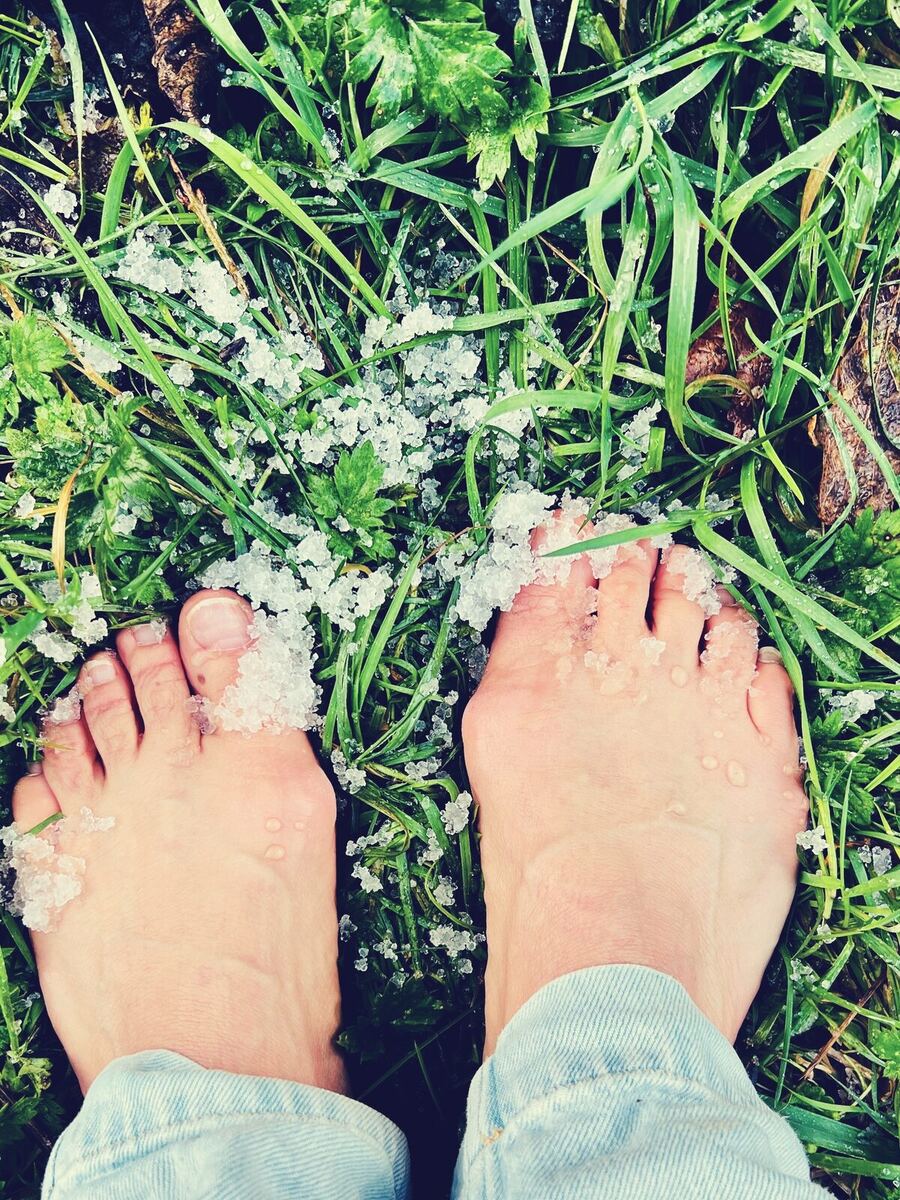
Finding Your Ground: The Wisdom of the Soil Beneath Our Feet
Walking barefoot. A simple, almost childlike gesture that brings us back to a primal sensation — that of our skin in direct contact with the world, without barrier, without filter. It is an experience that might seem insignificant, almost trivial, but which in fact holds an unsuspected depth for our body, our mind, and our soul.
In a daily life where everything moves fast, and when the great majority of us live in cities, walking barefoot becomes an act of resistance, a practice of slowness and listening. It is a way of reconnecting with our environment, of feeling the Earth that supports us, like a benevolent and unchanging presence. Beneath our feet, fresh grass, damp earth, soft or rough sand awaken every part of our being, stirring an ancestral memory within us.
Reconnecting with our natural grounding
Walking barefoot is far more than an exercise in relaxation or physical well-being. It is a grounding ritual, a way of returning to ourselves and rediscovering a sense of belonging to the world. Our feet, so often enclosed, relearn how to touch, how to feel. This direct connection reminds us that we too are made of earth, that we are the earth, and that we carry within us the echo of all those who walked before us.
This practice recentres us, strengthening our connection to the present. Each step invites us to slow down, to be attentive to every sensation that arises beneath our feet. To walk without shoes is to remember that we are not alone, that the Earth is here. By returning to this simplicity, we rediscover a form of inner safety and stability — the kind the Earth offers us tirelessly.
The practice of earthing: reconnecting with the Earth’s energy
“Earthing”, or “grounding”, is a practice that consists of walking barefoot on natural surfaces such as grass, sand or earth, in order to connect directly with the Earth’s energy. The idea rests on the principle that the Earth emits electrons that can have a beneficial effect on our body, helping to neutralise the electrical charges accumulated through our modern way of life, often disconnected from nature. Practitioners of earthing report effects such as reduced stress, improved sleep and the easing of physical pain. It is a return to an original connection, where the simple act of touching the ground allows us to feel a deep balance and to draw on the vital energy of the Earth.
The origins of earthing: an ancient wisdom rediscovered
The concept of earthing as a conscious practice gained popularity in the early 2000s, largely thanks to the research of Clinton Ober, a pioneer in this field. Ober co-wrote the book Earthing: The Most Important Health Discovery Ever?, published in 2010, which helped raise public awareness of the idea that direct contact with the Earth can have health benefits.
However, long before the term earthing was used, the idea of connecting with the Earth has been part of human practices for millennia. In many ancient cultures, walking barefoot on the Earth, practising rituals in direct contact with nature, or even sleeping directly on the ground was considered natural and essential for maintaining spiritual and physical balance. The benefits of earthing were then perceived intuitively, long before being studied and explained by modern science.
So although the term and the scientific research are relatively recent, the practice itself reaches back to our most ancient roots, where the Earth was seen as a source of healing and support.
A path toward releasing tension
By freeing our feet from their usual constraints, we also free our body. The points of support shift, tensions unwind, our posture rebalances. Our feet, sensitive and receptive, stimulate every zone of our being, a little like a silent massage that soothes our nervous system and invites letting go.
This practice reconnects us with our breath, with a slower and deeper breathing. We walk differently, more grounded, more aware of each movement. It is a path toward a relaxation that does not come through force, but through listening — a way of being at peace with ourselves and with the world.
Giving ourselves permission to feel
In this world where we are taught to walk fast, to always go further, let us walk barefoot simply to be. To feel the path beneath our feet, to sense life, to vibrate with the Earth. It is an act of reconciliation with ourselves, a meeting with that part of us that is always seeking to be heard — the one that remembers that, above all, we are beings of sensation.
An ancestral memory beneath our steps
To walk barefoot is also to walk with our ancestors. In an age when shoes had not yet forged a barrier between humans and the Earth, every step was taken directly on the ground, every movement became an instinctive dance with the elements. Our ancestors had this intimate relationship with the Earth; they felt life flowing beneath their feet, like a source of vitality and rootedness. By reconnecting today with this practice, we honour that memory buried within us, that heritage of presence and connection to what is essential.
And then, our greatest ancestor, in truth, is the Earth herself. She has carried us, nourished us, and shaped us over the millennia. She has been there from the beginning, the silent and benevolent witness of every step of humanity. To walk barefoot is to feel this continuity, to remember that, long before anything else, we belong to the Earth. It is to reconnect with her in her simplicity and her wisdom, to feel her surge of life beneath our feet and to pay homage to her, step after step.
A practice available at any moment: even in imagination
What if, the next time you had the chance — even just a few moments in your day — you let your feet feel the ground freely? This practice can be done quickly, taking the time to imagine the Earth beneath you if you cannot do it for real. Perhaps you would discover there a new alignment with yourself, a spark of peace, always present, always ready to be reborn.
To deepen this experience, you can listen to my recorded meditation on YouTube, which guides you into this connection.